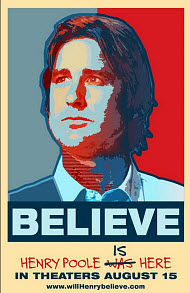
Henry Poole Is Here
 for thematic elements and some language.
Reviewed by: Taran Gingery
CONTRIBUTOR
| Moral Rating: | Better than Average |
| Moviemaking Quality: |
|
| Primary Audience: | Teens Adults |
| Genre: | Comedy Drama |
| Length: | 1 hr. 39 min. |
| Year of Release: | 2008 |
| USA Release: |
August 15, 2008 (500 theaters) DVD: January 20, 2009 |







Miracles, including list of biblical miracles
“Miracles are not possible,” some claim. Is this true? Answer
Is it logical to believe that the biblical miracles really happened? Answer
Is Jesus Christ really God? Answer


Are there biblical examples of depression and how to deal with it? Answer
What should a Christian do if overwhelmed with depression? Answer


Are you good enough to get to Heaven? Answer
How good is good enough? Answer
| Featuring |
Luke Wilson Adriana Barraza Dan Callahan, Earl Carroll, Noah Dahl, Gizza Elizondo, Elaine Anne Furst, Gloria Garayua, Beth Grant, Molly Hagan, Cheryl Hines, Marcus Maria Jung, Michelle Krusiec, Morgan Lily, George Lopez, Stephanie Mace, Kate Mulligan, Andrew Santino, Rachel Seiferth, Don Smith |
| Director |
Mark Pellington “Arlington Road,” “The Mothman Prophecies” |
| Producer | Michael Aguilar, Beth DePatie, Gary Gilbert, See all » |
| Distributor | Overture Films |
“Changing his attitude will take a miracle.”
Most people who move into a new neighborhood are usually at least friendly towards their new neighbors. Not so with Henry Poole (Luke Wilson). Henry just wants to be left alone. He even tells everyone that it doesn’t matter what they do, as he won’t be in his new little house in Los Angeles long enough for it to make any difference. He is a rude, angry and sad man, although he won’t say why.
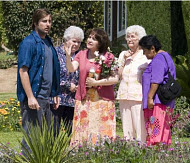
None of this deters his next-door neighbor, Esperanza Martinez (Adriana Barraza), who refuses to leave him alone, bringing him hot tamales and coming around every so often to check on him. Henry calls it being nosy, but Esperanza, a devout Catholic, believes that “those without faith need help the most.” So, when a mysterious water stain appears on the back wall of Henry’s house, Esperanza is convinced that it is in the shape of the face of Christ and therefore a miracle.
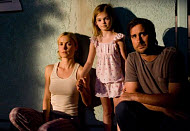
Henry is highly skeptical, accusing Esperanza of using her faith as a “vain hope” and largely ignores her and her pleas for his belief in favor of his other neighbors, Dawn (Rahda Mitchell) and her strangely silent daughter Millie (Morgan Lily), who records everything everyone says on cassette tapes. But as strange occurrences happen surrounding the watermark, Henry is forced to reexamine his beliefs and come to conclusions that will change his life forever.
First and foremost, it is important to say that this film never pokes fun at Christianity. Sure, Esperanza and her cronies are slightly eccentric in an endearing way, but they are never treated disrespectfully. The audience is never shown the watermark clearly enough to tell whether it is the face of Christ or not, but it is clear that the characters believe that it is, and we are invited to believe the same thing. The mark eventually starts to bleed and miracles of healing surround it. I believe in reality any such “mark” should be taken with a grain of salt, but for the purposes of the film, it serves as a powerful symbol.
The character of Henry Poole, played brilliantly by Wilson, refuses to believe the image has any power at all or that there even is an image. His stubbornness and resolve to explain away what he sees with his own eyes as “coincidences” are there for reasons I won’t give away, but let’s just say that Henry has a powerful argument for losing his faith. Eventually, though, through his relationships with Dawn, Esperanza and especially the estranged little Millie, we witness a man, broken and lonely, open up what is on his heart, come to terms with his past and, quite possible, with God.
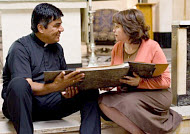
Other characters are equally strong. Esperanza is a woman of faith, who, although having to deal with her own grief, firmly believes in the power of prayer, the ability of God to work through every situation, even bad situations, and the importance of helping others. Dawn, in offering a listening ear and an open heart, is key to Henry’s emotional revival. Also of note, George Lopez in a brief role portrays Father Salazar as a compassionate and understanding man as well as a leader in the community. The importance of having both parents present for a healthy family is emphasized.
So, is there anything negative in this beautiful and uplifting little film? Unfortunately, yes. Some foul language is present, including a couple of s-words, and Henry often misuses the Lord’s name, as do a few others. Henry and Dawn’s relationship remains chaste, with only a few kisses and hand-holding, but Dawn does wear slightly revealing attire. In anger, Henry smashes the wall of his own house, causing part of it to collapse on him, putting him in the hospital.
In spite of those things, however, I highly recommend this film to any Christian, although it’s not for the younger kids, who would probably be bored by it anyway. The power of this story of a man’s journey of faith is both realistic and reverent and is ultimately a story worth hearing.
Violence: Mild / Profanity: Moderate / Sex/Nudity: Minor
See list of Relevant Issues—questions-and-answers.


This film sets out to tell a specific story and it accomplished with excellence. The script peppered characters with names such as Dawn (Radha Mitchell), Patience (Rachel Seiferth), and Hope is Esperanza in Spanish. Even “Poole” sounded like a body of water and there is a particular sequence where Henry was drenched in a water balloon fight and “surrendered,” at the end of that. A side note is that this film was probably still in production when actor Luke's older brother and fellow actor, Owen Wilson, shocked the world with his attempted suicide. Throughout HENRY POOLE IS HERE, there was no traces of Luke's personal drama unfold on the screen, only his professional take of the character and gave us a genuine Henry Poole.
There are foul languages but very minor compare to what the whole theme of faith and religion, although, Mark Pellington, the director have confessed to adheres to no particular faith. He had crafted an entertaining and some what compelling take on the subject of miracle.
Moral rating: Good / Moviemaking quality: 4½
Moral rating: Good / Moviemaking quality: 4½
The movie made me cry, it made me smile, but most of all it reminded me of the healing Jesus provides to us through His suffering and that we need to reach out to Him in faith and trust Him.
My Ratings: Moral rating: Better than Average / Moviemaking quality: 4